

How To Play Crazy Little Thing Called Love On Guitar
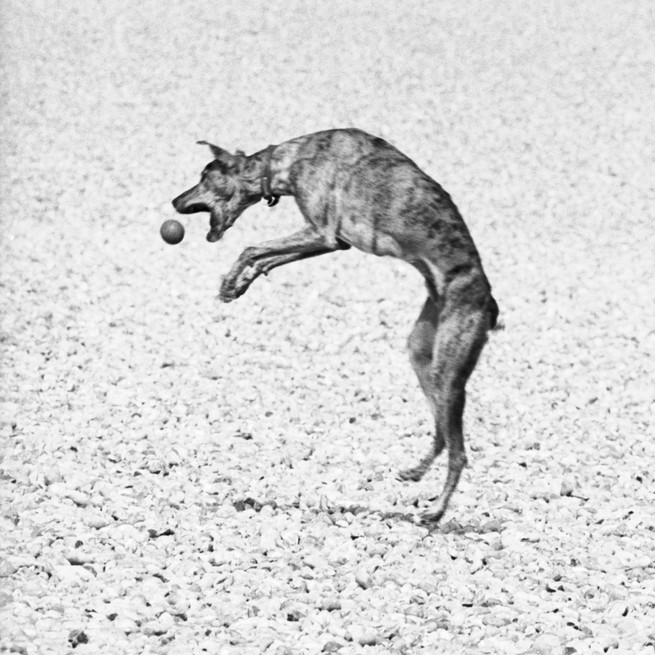
Anyone who has ever chucked a tennis ball in the full general vicinity of a edge collie knows that some animals take play very seriously—the intense stare, the tremble of anticipation, the credible joy with every bounce, all in pursuit of inedible prey that tastes like the backyard. Dogs are far from the only animals that devote considerable time and free energy to play. Juvenile wasps wrestle with hive mates, otters toss rocks between their paws, and human being children around the earth go to great lengths to avoid make-believe lava on the living-room floor.
When a dog chases a ball or a kid adjudicates relationship disputes in doll-land, something important and meaningful is clearly happening in their minds, says Laura Schulz, a cerebral scientist at MIT. "Play has a lot of peculiar and fascinating properties," she says. "Information technology'southward totally primal to learning and human intelligence."
Scientists accept play seriously likewise. For decades, psychologists, evolutionary biologists, and animal behaviorists, among others, have labored to understand the playful listen. They have given toys to octopuses, fix upwardly wrestling matches for rats, trained cameras on wild monkeys in the jungle and on semi-domesticated children on the playground. Their biggest question: What do these creatures get out of playtime? Clarifying the motivations and benefits of play could tell us much virtually behavior and cognitive development in people and other animals, Schulz says.
Answering this question, however, has proved surprisingly difficult. Some of the most obvious explanations haven't held up to scientific scrutiny.
One hypothesis, for instance, is that play helps animals learn of import skills. But experiments haven't borne this out. A 2020 study of Asian small-clawed otters living in zoos and wildlife centers institute that the virtually defended rock jugglers weren't any better than their not-juggling friends at solving food puzzles that tested their dexterity, such equally extracting treats jammed within a tennis brawl or nether a screw-top chapeau.
Researchers were surprised, but the otters were confirming the long-standing theory that animals don't seem to acquire much through play. Previous studies had constitute that kittens that grow up surrounded past cat toys aren't especially successful hunters as adults, and playful juvenile meerkats aren't whatever better in machismo at managing territorial disputes.
As Schulz and a colleague write in the Almanac Review of Developmental Psychology, fifty-fifty human being children, arguably the most playful creatures in the world, don't seem to reap any definitive long-term emotional or developmental benefits from pretend play, an elaborate and well-studied form of human play. Whether studies await at creativity, intelligence, or emotional control, the benefits of play remain elusive. "Y'all can't say that kids who play more are smarter or that kids who engage in more pretend play practice ameliorate," Schulz says. "None of that is true."
Play is actually somewhat rare in the beast world—you're unlikely to run into a playful rattlesnake, a recreating eagle, or a whimsical bullfrog—which only deepens the mystery of why it exists at all, says Sergio Pellis, a behavioral neuroscientist at the Academy of Lethbridge, in Alberta, Canada, and a co-author of the 2010 volume The Playful Brain. Development normally encourages behaviors that assistance a species survive and propagate. Information technology doesn't favor fun for fun's sake. Play "isn't similar eating or sexual activity," Pellis says. "We have to explain why it shows upwards in some lineages just non others."
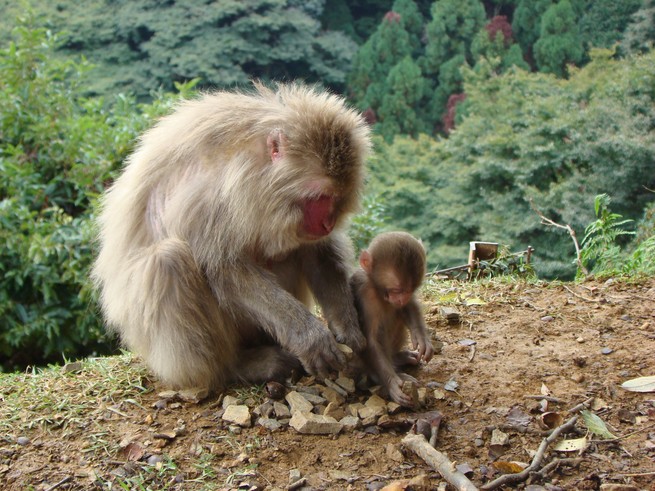
Playfulness likewise varies from ane private to another, giving scientists the chance to compare playful otters, kittens, and meerkats with their more pragmatic peers, says Jean-Baptiste Leca, a cultural primatologist and a colleague of Pellis's at the University of Lethbridge. Leca has spent much of his career studying macaque monkeys that play with rocks in the jungles of Bali and the forests of Nihon. They ballyhoo rocks together and move them around, scratching the footing. (Tourists often wonder if the monkeys are trying to write, but they aren't at that place … withal.)
Some macaques really comprehend the hard-rock lifestyle, which Leca sees equally an important personality trait. "Twenty-five years agone, saying that animals had personalities was almost taboo," he says. At present the idea is more than accepted. "Animals vary a lot in their boldness and their willingness to try new experiences." And so far, he has seen no bear witness that playing with rocks helps macaques learn to put rocks to a applied use, such as swell open up tough nuts. Anecdotally, he'southward seen some especially playful immature monkeys become the leaders of their troops, simply information technology's unclear whether having stone-playing on their résumés had any bearing on their promotion.
Children, of course, accept personality for miles, and some kids are more playful than others. But there's nevertheless no clear connection between playfulness and overall abilities, says Angeline Lillard, a psychologist at the University of Virginia. Lillard and colleagues reviewed the state of the scientific discipline on pretend play and cognitive development in a 2013 report in Psychological Bulletin. Whether studies looked at problem-solving, creativity, intelligence, or social skills, there was no consistent sign that playful children had whatsoever advantages. "People will say, 'Absolutely, pretend play helps development,' merely nosotros couldn't find any good evidence," Lillard says. She thinks subsequent studies have failed to clarify the motion picture.
So if play isn't making animals smarter and honing their life skills, what tin can it possibly be good for? Its purpose must be subtler and perhaps more than fundamental than once thought, Pellis says. Play may non heighten easy-to-mensurate things like IQ, just it may prime the brain to cope with the challenges and uncertainties of life. Consider rats, some of the most play-hungry animals on the planet. When young rats wrestle and run effectually, Pellis says, they're testing boundaries and exploring new possibilities: What happens when I jam my snout in that other guy's neck? Volition he chase me if I run? How difficult tin can I nip at him without getting attacked?
Those lessons thing. Studies by Pellis and others take plant that young rats deprived of playmates grow up with a less adult prefrontal cortex, a role of the brain deeply involved in social interactions and determination making. These animals too tend to experience deficits in short-term memory, impulse control, and the ability to find or react to threatening gestures from other rats. "If you don't have play experience with peers, you're not as good at fighting, you're not as good at having sexual activity, and you're not as proficient at coping with a novel environment that y'all haven't encountered before," Pellis says.
Pellis suspects that it doesn't take a lot of play to prevent these deficits. Studies of rats, basis squirrels, and other rodents suggest that young animals need to experience simply a picayune play to have a fully formed prefrontal cortex, comparable to those of their more than playful peers. After that threshold is reached, it really does seem to be all fun and games.
Another possible caption for play, Leca says, is that it'southward an evolutionary by-production. He notes that many animals, especially young ones, take an innate need to explore and experiment, a trait that could be useful for discovering nutrient sources or learning other important lessons. This thirst for novelty tin tip over into playful behavior for animals that have the brain power, the extra fourth dimension, and the resources to think about anything other than their immediate survival.
Pellis notes that octopuses don't seem to play much in the wild, presumably because they are then busy trying to hide, eat, and survive. But given a toy in a tank, they're like toddlers with extra appendages. Howler monkeys certainly have the brainpower for fun, but they spend so much time lying around trying to digest their high-fiber diets that they rarely bother to recreate, especially compared with their high-flying, fruit-eating spider-monkey neighbors.
Even if play serves no evolutionary purpose, it may yet be rewarding. Studies evidence that wrestling rats enjoy a rush of dopamine and other brain chemicals that aid regulate emotion and motivation. The surge of dopamine, which activates the brain's advantage pathway, is especially intense in younger animals—potentially explaining why youngsters of many species are more playful than their elders. As Pellis explains, the canis familiaris that lives to chase tennis balls has discovered a way to exploit that reward system again and over again. And considering dogs have been bred over many generations to essentially act similar perpetual puppies, that rush—and the joy that seems to accompany it—never really goes abroad.
Children also find deep rewards from play. In her years of observing children, Schulz has been struck past the way they create completely unnecessary obstacles in the name of fun. Just similar other playful creatures, they seem to have an inborn need to try new things. But instead of simply wrestling a friend or smacking rocks together, kids will spend hours building a paper-thin rocket or hopping between arbitrary chalk lines on a sidewalk.
Schulz suspects that this kind of pretend play has some benefits, even if they are hard to measure out. "Pretending to fight dragons won't brand you any better at fighting dragons," she says, just it might be useful in other means. "They're setting up a cognitive infinite where they can create a problem and then solve information technology."
The sort of mental flexibility and determination required to fight dragons might fifty-fifty come in handy in the confront of some future real-world challenge. Pretend play may also help children develop self-command and, paradoxically, understand the line between play and reality, Lillard wrote in a 2017 paper in Trends in Cognitive Sciences. She notes that just as wrestling rats or puppies chop-chop learn that they shouldn't bite their friends during roughhousing, children who create a pretend world learn that they shouldn't take their imagination as well far: That mud cookie isn't going to taste great, and that cape doesn't actually make flight possible.
Fanciful role-playing that involves feelings, such as pretending to be scared or triumphant, can help some children empathize and command their emotions, says Manfred Holodynski, a developmental psychologist at the Academy of Münster, in Germany. When children enact emotions they don't genuinely experience, "that requires an awareness of how emotions work," Holodynski says. Just make-believe has its limits. In a 2020 study, he found that children pretending to be under a magical spell that forced them to smile still couldn't muster a halfway-convincing smiling when they received a disappointing present. (As previously reported in Knowable, fake smiles are challenging for adults also.)
For all of the uncertainties about play, researchers say information technology still deserves a identify in our lives. Lillard says that schools and parents alike should requite children the time and opportunity to detect their personal play styles, simply she cautions that play should be voluntary and enjoyable, non part of a high-stakes kid-improvement plan. "Parents today feel very guilty if they are not pretending with their children," Lillard says. "They're made to feel that they're harming their children. But they aren't. Information technology's actually a shame that they're feeling that force per unit area."
Equally a scientist and mother of four, Schulz has developed her ain approach to play. If ane of her kids is playing a video game, she has no trouble interrupting them for dinner. But if a kid is deep in pretend play, she'll leave them to their mission, wherever it's taking them. "We don't actually know what play is doing in early childhood," she says. "Until we understand it amend, nosotros can concur that it'south fun."
That's one point that all involved parties—whether psychologists, edge collies, or meerkats—tin can back up. Play is fun, and fun is adept.
This post appears courtesy of Knowable Magazine.

How To Play Crazy Little Thing Called Love On Guitar,
Source: https://www.theatlantic.com/science/archive/2021/04/why-animals-play/618484/
Posted by: lealnessiogs.blogspot.com
0 Response to "How To Play Crazy Little Thing Called Love On Guitar"
Post a Comment