

Electric Flux Of A Cylinder
Electric Flux: Definition & Solved Examples
Definition of electric flux:
Permit u.s.a. suppose a rectangular loop in management of flowing water is placed such that the plane of the loop is perpendicular to the menses of h2o. Let $A$ be the area of the loop and $v$ be the velocity of the water.
In this case, the rate of flow of water through the loop, which is denoted past $\Phi$, is divers as $\Phi=Av$ where $\Phi$ is called the flux.
If the loop is non perpendicular to the flow of water so that information technology makes some angle $\theta$ with the catamenia, in this case, the flow is divers as $\Phi=A\left(v\,\cos\theta\correct)$.
This is similar to the electrical field. From electrostatic recall that the electrical field due to a collection of charges is visualized by some lines which are called the field lines.
On the other hand, any imaginary airtight surface has a unit vector perpendicular to it. This unit of measurement vector is chosen the normal vector.
The coordinating to electric flux is the magnetic flux which is a measure of how many magnetic field lines pass through a surface.
Unit vectors in Cartesian coordinate are described on the page below with a couple of solved bug
Unit of measurement vector solved issues
The concrete method for finding the flux of electric field through any closed surface is as follows: Once the angle between $\vec E$ and normal vector $\hat n$ to the surface of expanse $A$ is $\theta$, it is sufficient to multiply the electric field due to the existing 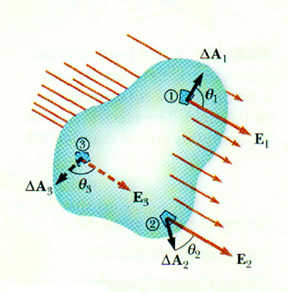 field lines in the closed surface by the area of the surface.
Since the electric field is non compatible beyond the whole surface so one can carve up the surface into minute parts which are called the area elements $dA$.
At present that the electric field beyond this minute element is rather compatible past multiplication of $\vec Due east$ and $d\vec A$, where $\vec A$ is the vector surface area of the surface and summing these contributions we can go far at the definition of electrical flux \brainstorm{marshal*} \Phi_E &\approx \vec E_1 \cdot \Delta \vec A_1+\vec E_2 \cdot \Delta \vec A_2+\cdots+\vec E_n\cdot \Delta\vec A_n\\&=\Sigma\vec E_i\cdot\Delta \vec A_i\cease{align*} In the limit of $\Delta A \rightarrow 0$, this discrete and approximate sum goes to a well-defined integral.
The mathematical language is as follows \[\Phi_E=\int_S{\vec E\cdot \chapeau n d\vec A}=\int_S{\vec Due east\cdot d\vec A}\] Dot denotes the scalar product of the 2 quantities.
The right-mitt side of the above, which is chosen the surface integral, in cases that the desired surface and/or electric field varies arbitrarily is a difficult task to compute.
The adding is straightforward when the charge distribution is totally symmetric since in this instance, one can choose simply a suitable surface.
Summary:
The number of electric field lines that pass through any closed surface is called the electrical flux which is a scalar quantity.
Electrical flux solved examples
In the following, a number of solved examples of electric flux are presented. More simple problems including flux of uniform or non-compatible electrical fields are besides provided.
Instance (1): electric flux through a cylinder.
Suppose in a uniform electrical field a cylinder is placed such that its centrality is parallel to the field.
To compute the flux passing through the cylinder we must dissever information technology into iii parts acme, bottom, and curve so the contribution of these parts to the total flux must exist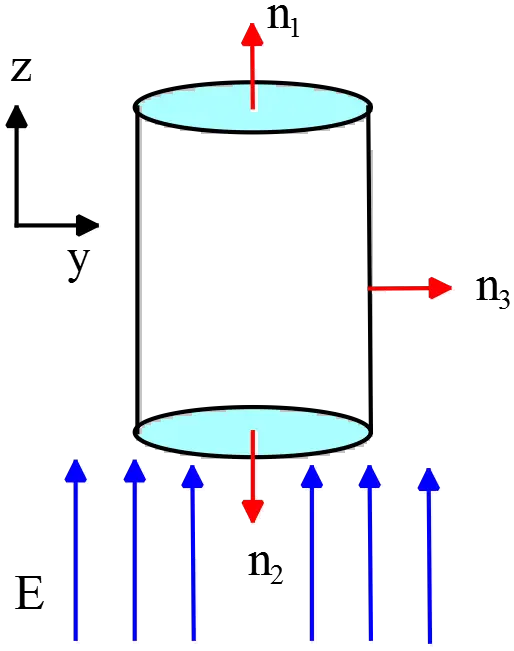 summed.
On the top and bottom sides, the unit normal vectors are $\hat thou$, $-\hat grand$, respectively. Permit $\vec Due east$ be toward the $z$ axis i.e. $\vec E=E\chapeau k$.
Scalar products of top and lesser sides by electric field make the full flux since the normal vectors and $\vec E$ are parallel ($\theta =0$) and antiparallel ($\theta=180^\circ$), respectively.
The bend side has a normal vector in the radial management which makes a correct bending($θ=90^\circ$) with $\vec E$ and so its contribution to the flux is null. \begin{align*} \oint{\vec E\cdot \hat north dA}&=\int{\vec E_1\cdot\hat k dA_1}+\int{\vec E_2 \cdot \left(-\hat thousand\right) dA_2}\\ &+\int{\vec E_3 \cdot \hat r dA_3}\\&=E_1 A_1 -E_2A_2\end{marshal*}
$E_1$, $E_2$ and $E_3$ are the amount of electric fields passing through the surfaces. Since the electrical field is uniform one can gene it out of the integral.
$A_3$ is the expanse of the curved side which is $ii\pi Rl$. The electric field lines don't pass through the curved sides and merely penetrate pinnacle and lesser which in this example their amounts are the same $E_1=E_2$.
Therefore, the total flux through the cylinder is simply \[\Phi_E=0\]
This result is expected since the whole electric field entering the bottom side exiting the top surface.
Example (2):
A hemisphere of radius $R$ is placed in a uniform electric field such that its cardinal axis 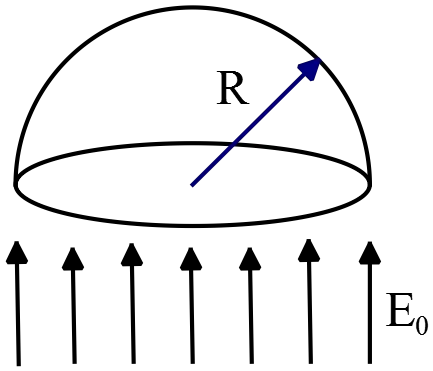 is parallel to the field. Find the electric flux through it?
Solution:
Let the electric field be in the $z$ direction i.eastward. $\vec E=E_0 \hat grand$. The normal vector to the hemisphere is in the radial direction then $\hat due north=\chapeau r$. Further, the surface area element of a spherical surface of a constant radius in the spherical coordinate is 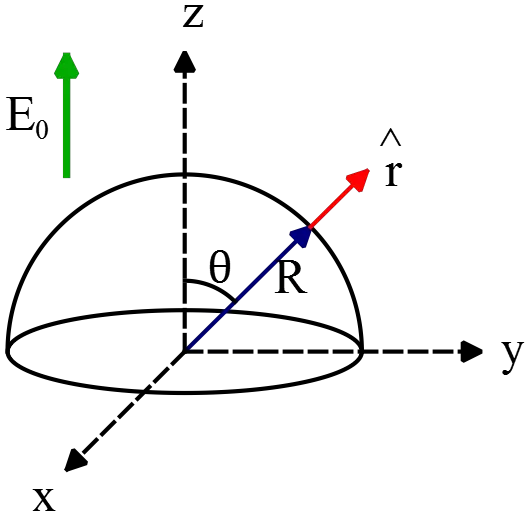 $dA=R^{2}\,\sin\theta\, d\theta d\phi$.
Therefore,
\begin{align*}\Phi_E&=\int{\vec East\cdot \hat n\,dA}\\&=\int{\left(E_0\hat thousand\right)\cdot \lid r R^{ii}\,\sin \theta d\theta d\phi}\terminate{align*}
No we must find the scalar product of $\lid r\cdot \hat yard$. In spherical coordinates we have the following relation for the unit vector in the radial direction:
\[\chapeau r=\sin \theta \cos \phi \, \chapeau i+\sin \theta \sin \phi \, \hat j+\cos \theta \, \chapeau k\]
Where $\lid i,\hat j,\hat k$ are the usual unit vectors in the Cartesian coordinates. Thus
\[\hat r\cdot \lid k=\cos \theta\]
Where we have used the fact that $\hat i\cdot \chapeau k=\hat j\cdot \hat k=0$ and $\hat g\cdot \chapeau yard=1$. Putting everything into the electric flux relation, 1 can obtain
\begin{align*}\Phi_E&=E_0R^{2}\int_0^2\pi{d\phi}\int_0^{\pi/2}{\underbrace{\cos \theta \sin \theta}_{\frac 12 \sin 2\theta}d\theta}\\&=E_0R^{ii}\left(2\pi\correct)\frac 12\left(-\frac 12\,\cos two\theta\correct)_0^{\pi/2}\\&=\pi E_0R^{2}\terminate{marshal*}
Example (iii):
consider a planar disc of radius $12\,{\mathrm cm}$ that makes some angle $xxx^\circ$ with the compatible electrical field $\vec E=450\,\hat i\,\mathrm {(N/C)}$. What is the amount of electrical flux passing through it?
Solution:
Permit the electric field be in the x-direction and normal to the airplane be in some direction $\hat north$ which must be decomposed into the $x$ and $y$ directions, equally shown in the 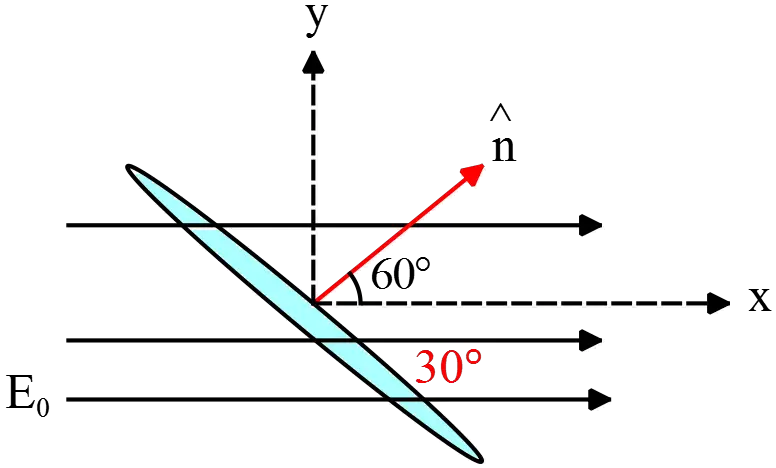 figure. Using the definition of electrical flux, nosotros have
\begin{align*} \Phi_E&=\int{\vec E\cdot \lid n dA}\\&=\int{E_0\hat i \cdot\left(\cos 60^\circ\,\hat i+\sin 60^\circ \,\chapeau j\right)dA}\\&=E_0\,\cos 60^\circ\int{dA}\end{align*}
Where the integral over $dA$ is the area of the disk which is $\pi R^{2}$. Therefore
\begin{marshal*}\Phi_E&=E_0\left(\frac 12\right)\left(\pi R^{2}\right)\\&=(450)\left(\frac 12 \correct)\pi (0.12)^{2}\\&=x.17 \quad \rm {\frac {Due north\cdot m^{2}}{C}}\end{align*}
Some other method for finding electrical flux due to systems with high symmetry is to use Gauss's constabulary. You can also acquire this elegant method with some unproblematic problems.
Author: Ali Nemati

Electric Flux Of A Cylinder,
Source: https://physexams.com/lesson/Electric-Flux_10
Posted by: lealnessiogs.blogspot.com
0 Response to "Electric Flux Of A Cylinder"
Post a Comment